PIR vs PU Sandwich Panels: Key Differences Explained
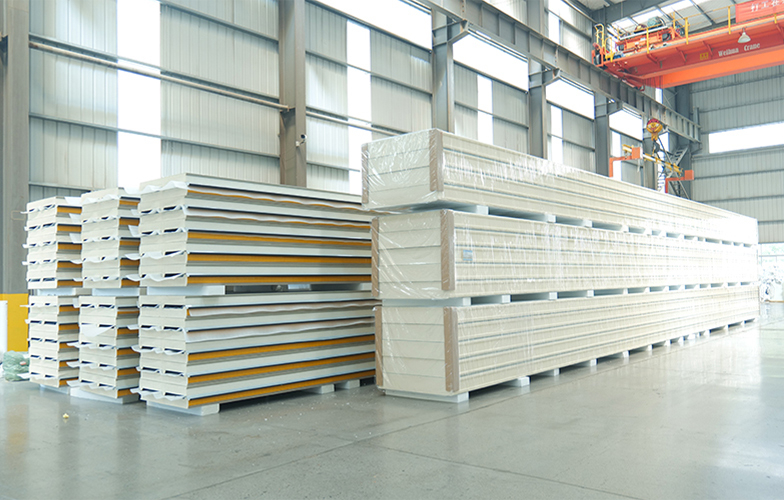
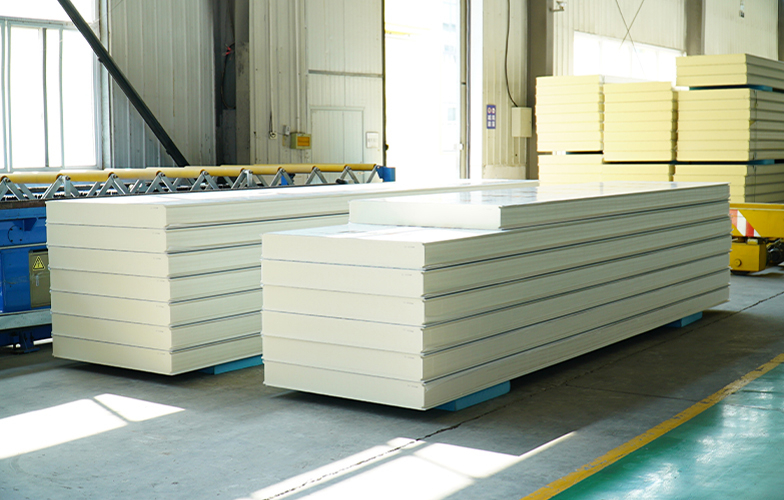
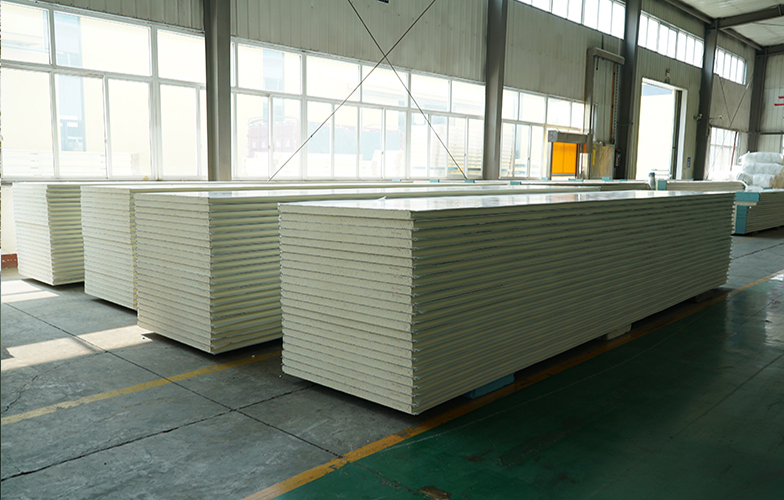
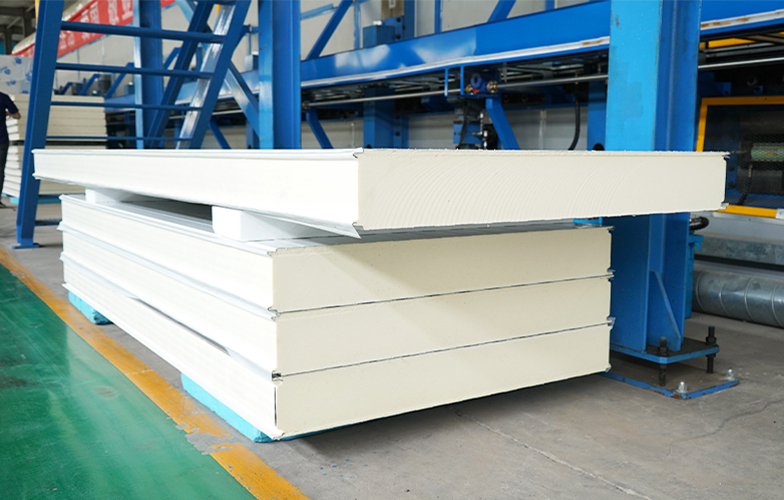
PIR (polyisocyanurate) and PU (polyurethane) sandwich panels both use a rigid closed-cell foam core bonded between two metal facings, and they perform much the same in insulation value, weight and installation speed. The practical differences come down to three things: fire behaviour, heat resistance and cost. PIR cores char and resist flame spread better and tolerate higher service temperatures, which is why PIR is specified where fire regulations are strict. PU cores hold an edge in low-temperature insulation per dollar, which keeps them the standard choice for cold storage.
This guide explains the chemistry behind that difference, compares the two panels side by side with realistic numbers, and — most importantly — shows you how to verify which foam you are actually buying.
The Short Answer
Choose PIR when the building code demands a better reaction-to-fire class, or when the panel sits in a high-temperature environment.
Choose PU for cold storage, freezers and general insulated buildings where cost per square meter matters most.
Choose mineral wool if the code requires non-combustible insulation (class A1/A2). Neither PIR nor PU is non-combustible.

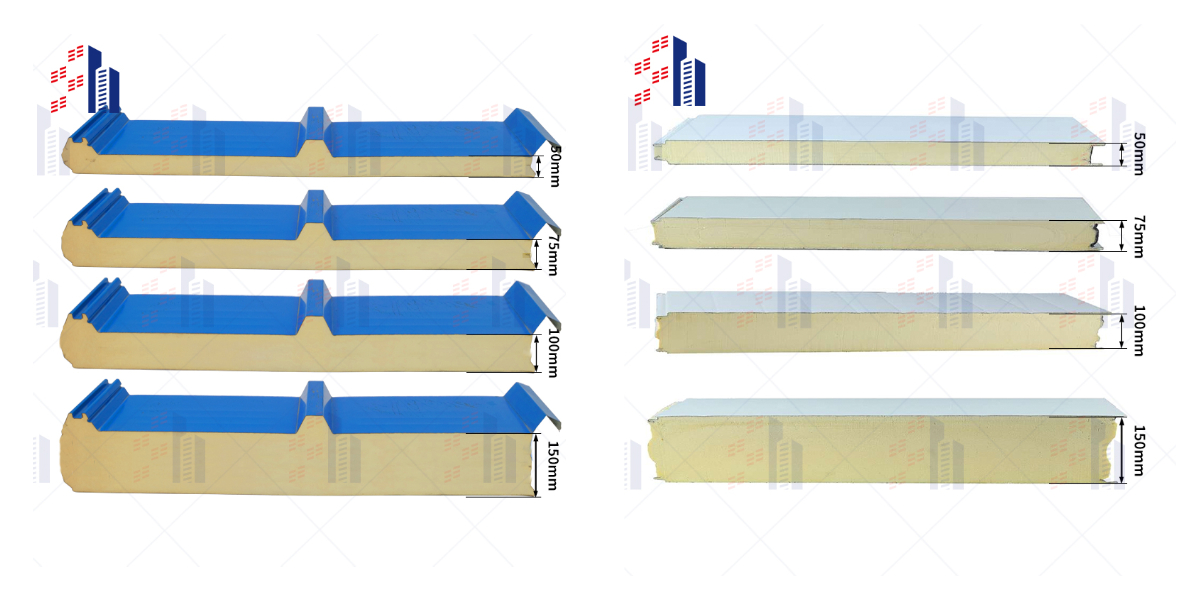
Same Family, Not the Same Foam
PU and PIR are cousins. Both are made by reacting a polyol with isocyanate, and both are produced on continuous lamination lines where the foam is injected between steel facings and cured under pressure.
The difference is the formulation index — the ratio of isocyanate to polyol:
PU uses a lower index (roughly below 180). The result is a rigid, closed-cell foam with excellent insulation and good mechanical strength.
PIR uses a higher index, which drives a chemical reaction called trimerization. The polymer develops isocyanurate rings that make the foam more cross-linked and more thermally stable.
That single formulation change produces the two behaviours buyers care about: PIR forms a protective char layer when exposed to flame instead of dripping and spreading flame, and it keeps its dimensional stability at higher temperatures.
| Property | PU (polyurethane) | PIR (polyisocyanurate) |
| Formulation index | Roughly below 180 | Roughly above 180 (isocyanurate rings) |
| 0.022–0.028 W/(m·K) | 0.022–0.028 W/(m·K) | 0.022–0.028 W/(m·K) |
| Core density (typical) | ~35–45 kg/m³ | Similar range, often slightly higher |
| Reaction to fire, EN 13501-1 (typical) | Commonly class C or D; better grades with additives | More likely to reach class B-s1/s2,d0 |
| Continuous service temperature (typical) | ~90–110 °C | ~120–150 °C |
| Behaviour in fire | Softens and can spread flame | Forms a char layer, resists flame spread |
| Insulation at very low temperature | Slightly better | Slightly behind |
| Long-term performance at high temperature | Lower | Better thermal stability |
| Relative cost | Lower | Higher (more isocyanate) |
All figures are typical industry values for orientation only. Actual performance depends on the supplier's formulation, core density and the tested panel system — always use the manufacturer's datasheet and test report.
Fire Performance: Where PIR Actually Wins
This is the real reason PIR exists. When a PU core is exposed to flame, the foam softens and can contribute to flame spread. A PIR core reacts differently: the surface degrades into a carbonaceous char layer that shields the foam underneath and slows flame spread.
In practice:
PU cores commonly achieve EN 13501-1 class C or D. Some formulations with flame retardants reach class B, but this is formulation-specific.
PIR cores more readily achieve class B-s1,d0 or B-s2,d0 — the class most often required for building envelopes in fire-regulated markets.
Neither reaches A1/A2. Those classes require a mineral wool core.
The honest caveat: fire classification applies to the exact panel assembly that was tested — core, facings, adhesive and thickness together. Small-scale test results do not guarantee large-scale fire behaviour, and both foams still produce smoke. Compartmentation, sprinklers and correct detailing remain part of the design. Before ordering, ask for the test report, not a marketing line, and check which thickness and facing combination it covers.
Thermal Performance: A Small Edge for PU in the Cold
On paper the two are almost twins: both foams typically sit in the 0.022–0.028 W/(m·K) range. The differences show up at the extremes:
At very low temperatures, PU foam retains a slight insulation advantage, which is one reason it dominates freezer and cold-storage panels.
At elevated temperatures, PIR holds its insulation value and its dimensions better, and ages more predictably under heat.
So for a −18 °C or −25 °C cold room, PU is usually the more economical and proven choice. For a roof or an industrial envelope exposed to solar heat or process heat, PIR narrows the gap or takes the lead.
Heat Resistance and Where the Panel Sits
Because PIR cores tolerate roughly 120–150 °C continuous service temperature against about 90–110 °C for PU, PIR is the safer option next to ovens, hot process lines, exhaust areas and flat roofs that run hot in summer. If the panel will live at 60 °C and below, that advantage rarely justifies the price difference by itself.
Cost and Total Value
PIR costs more because its formulation contains more isocyanate. The gap varies with the market and order size, so treat any fixed percentage you read online with suspicion.
The better comparison is installed cost against the code requirement:
If the building code accepts class C/D insulation, PU does the job at a lower price.
If the code requires class B, comparing PIR against PU-with-additives often lands close — and comparing PIR against mineral wool usually favours PIR.
If the code requires A2 non-combustible, PIR is not an option and the comparison becomes mineral wool versus redesigning the assembly.
Which Panel Should You Choose?
| Your situation | Recommended core |
| Cold storage, freezers, chilled rooms | PU |
| Building envelope in a fire-regulated market (class B required) | PU |
| Panel near ovens, hot process lines, hot roof deck | PIR |
| Retail, public or high-rise buildings with strict envelope rules | PIR, or mineral wool if class B is not enoug |
| Code requires non-combustible (A1/A2) insulation | Mineral wool — neither PIR nor PU |
| General warehouse, factory, agricultural building with no fire-class requirement | PU |
How to Verify You Are Actually Buying PIR
This is the part most guides skip, and it is where buyers get hurt. "PIR" is used loosely in the market, and some panels sold as PIR are ordinary PU foam.
Ask the supplier for these four items before you commit:
The core datasheet — density, thermal conductivity, and the isocyanate index if stated.
The EN 13501-1 classification report for the panel system — not just the foam, and check the thickness and facing combination tested.
The continuous service temperature in writing.
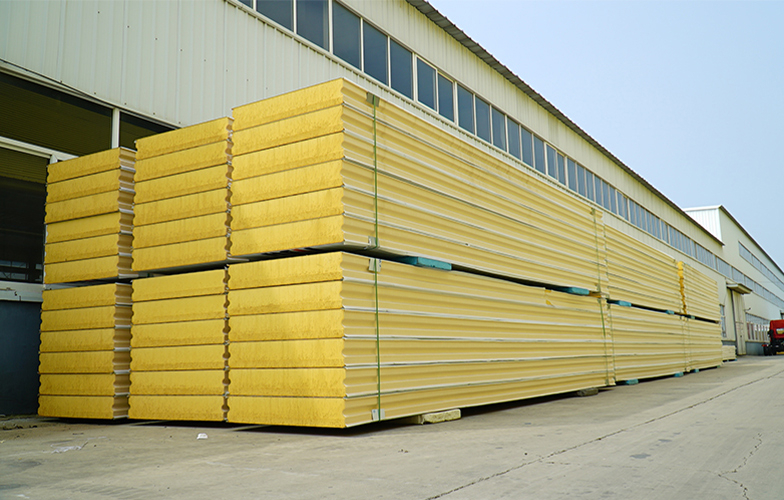
A core sample. Inspect the foam: both are rigid and yellowish, and colour is not a reliable identifier — but a sample lets you check density, cell uniformity and bond quality to the facings.
If a supplier cannot produce items 1 and 2, price the quote as ordinary PU and make your decision on that basis.
FAQ
Q: Is PIR better than PU? A: Only where fire performance or high-temperature resistance matters. PIR has a better reaction-to-fire profile and higher service temperature. PU is slightly better in low-temperature insulation and costs less. For a standard cold room, PU is often the smarter buy.
Q: Is PIR fireproof? A: No. PIR is still a combustible foam — it simply performs better than PU because it forms a protective char layer. Non-combustible insulation (class A1/A2) requires a mineral wool core.
Q: Which one insulates better? A: At ambient temperatures they are nearly identical (both around 0.022–0.028 W/(m·K)). PU has a slight advantage at very low temperatures; PIR holds up better at high temperatures and over long-term heat aging.
Q: Can PIR panels be used for cold storage? A: Yes, and they often are — particularly where the local fire code requires a class B envelope. Expect to pay more, and confirm the U-value you need at the panel thickness you have room for.
Q: How can I tell if a supplier is quoting real PIR? A: Ask for the core datasheet with the isocyanate index and the EN 13501-1 test report for the full panel system. If those documents are missing, treat the claim as unverified and negotiate accordingly.
Why Buy Sandwich Panels from SHANGHE?
SHANGHE is a China-based manufacturer of insulated sandwich panels and prefabricated building systems, supplying PU, PIR, EPS and mineral-wool-core panels plus modular building materials to project buyers worldwide. Working directly with the factory gives you:
Core selection matched to your code — PU where cost-efficiency leads, PIR where the fire class demands it, mineral wool where non-combustible insulation is mandatory
Specification support — thickness and U-value guidance based on your climate, building type and local requirements
Documentation — core datasheets and test reports so you can verify what you are buying instead of trusting a label
Direct factory pricing with clear MOQ, lead time and sea-freight packaging
Get a project quote: tell us your building type, location, required U-value or fire class, panel area and quantity — our export team will come back with a specification recommendation and a quotation.